house-view-q1-2026

Bending not breaking

  • The global economy enters 2026 bending but not breaking. Growth should remain near trend, supported by easier fiscal and monetary policy, healthy private-sector balance sheets, and structural tailwinds from AI. Inflation is uneven and sticky – largely due to the US – but trending lower elsewhere. While fundamental and political uncertainty stays elevated, we believe it has passed its peak – although investors should monitor any market volatility in anticipation of the US midterms or Fed chair transition.
  • This backdrop is favourable for risk assets, even as we acknowledge that we are in a late-cycle expansion where potential rewards may be lower and potential risks higher than in previous quarters. Geopolitical risk cannot be ignored – as the US intervention in Venezuela at the start of the year reminds us.
  • For investors, AI remains a critical theme – but one to approach with discipline and diversification. We do not believe the sector is in bubble territory, and missing out on further upside could be costly. However, concentration risk is real. The opportunity set is broadening to applications driving demand for computing power, energy, and enabling tech. This calls for a diversified approach: across tech subsectors, geographies and adjacent innovation themes. At the same time, investors should monitor credit default swap spreads for major AI firms, which could signal emerging credit risks.
  • Overall, we have raised our pro-risk stance, favouring diversification across asset classes and geographies. Europe offers selective opportunities despite fading momentum in some markets, while Asia remains undervalued in both equities and FX. Pairing exposure to structural growth drivers like AI with positions in emerging markets, precious metals, and undervalued currencies can help balance risk and reward in what we expect to be a resilient yet complex year where active management will be critical.

Icon

Chart of the quarter

Is US growth inclusive?
At first glance, the US economy looks resilient. But dig deeper, and the picture becomes more uneven. A “K-shaped” economy is taking hold: the upper arm of the K reflects higher-income households continuing to spend freely, while the lower arm shows lower-income Americans squeezed by persistent price pressures. If this divergence persists, questions could emerge about the durability of growth.
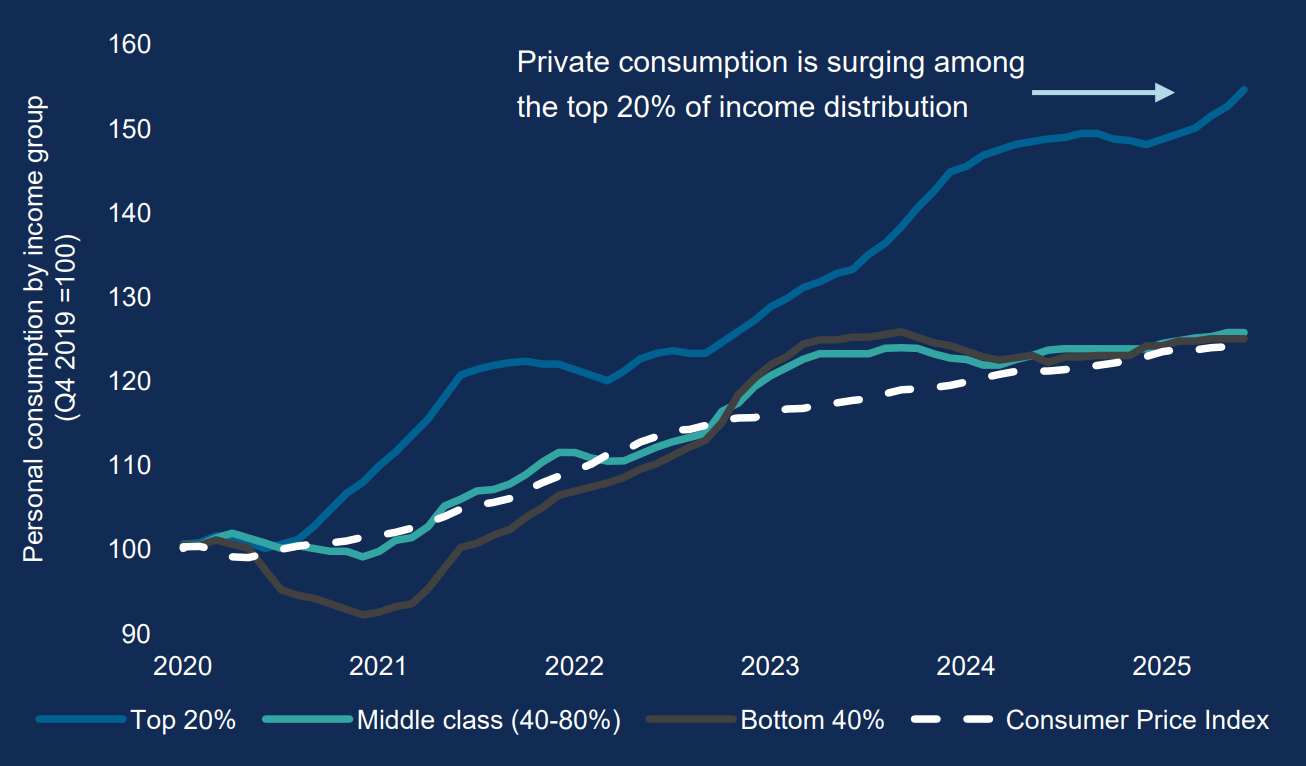
At first glance, the US economy looks resilient. But dig deeper, and the picture becomes more uneven. A “K-shaped” economy is taking hold: the upper arm of the K reflects higher-income households continuing to spend freely, while the lower arm shows lower-income Americans squeezed by persistent price pressures. If this divergence persists, questions could emerge about the durability of growth.

Note: Private consumption based on Moody’s calculations (through Q2 2025). Source: Moody's and Bloomberg.

Short on time? Download the summary of our House View Q1.

Asset class convictions

Asset class convictions: equities

  • While US valuations appear high, especially in the concentrated larger-cap segment, there remain opportunities, in part due to the return of manufacturing capex.
  • Europe’s drive for strategic autonomy persists, with expansive fiscal policies providing significant stimulus. Meanwhile, efforts to further mobilise private capital via the nascent EU Savings and Investment Union will continue.
  • A wave of AI diffusion in China is dovetailing with the depth and breadth of domestic supply chains, as well as a flourishing ecosystem of innovative start-ups. Alongside a surge in biotech out-licensing, and ongoing pensions and insurance reform, China should provide fertile ground for investors in 2026.
  • India’s aspiration economy – fuelled by rising digital penetration, income growth, and increasing formalisation – continues to build momentum.
  • In terms of sectors, life sciences seem to be turning a corner with the headwinds of recent years transforming into more positive momentum. For instance, destocking in the wake of Covid has ended, while the overhang from US spending cuts has mitigated. The long-term case for AI’s transformative effects remains solid despite short-term frothiness; growing power demands are supportive of utilities.

The statements contained herein may include statements of future expectations and other forward-looking statements that are based on management's current views and assumptions and involve known and unknown risks and uncertainties that could cause actual results, performance or events to differ materially from those expressed or implied in such statements. We assume no obligation to update any forward-looking statement.

Asset class convictions: fixed income

  • Divergence in global bond markets favours an active approach to duration management.
  • In core markets such as the US, we favour shorter-dated government bonds. We still expect the US yield curve to steepen given insufficient term premia in longer-dated bonds.
  • Some markets are approaching the end of monetary easing cycles; favour yield curve flatteners in markets such as Canada.
  • For longer-dated exposure, consider emerging market sovereign debt issued by Brazil, Peru and South Africa, where real rates are attractive and central banks have leeway to cut rates.
  • In foreign exchange, we see building tailwinds for deeply undervalued Asian currencies given a supportive policy backdrop and abating trade uncertainty.
  • In investment grade credit, pricing is fair, supported by solid fundamentals and strong technicals; we prefer more senior parts of the capital structure, favouring financials and utilities over cyclical industrials.
  • Although default risk is broadly manageable, high yield bonds demand a diversified and selective approach in a late cycle. Emerging market corporates and Asia high-yield provide credit cycle diversification and decent risk-reward.

The statements contained herein may include statements of future expectations and other forward-looking statements that are based on management's current views and assumptions and involve known and unknown risks and uncertainties that could cause actual results, performance or events to differ materially from those expressed or implied in such statements. We assume no obligation to update any forward-looking statement.

Asset class convictions: multi asset

  • We are optimistic on risk assets despite recent market volatility – and uncertainty around US data and the Fed’s interest rate path.
  • Equities are our preferred asset class, supported by resilient AI-driven earnings. We maintain balanced regional exposure, with stronger convictions especially on emerging markets. We also rebalance from US tech into Asia. In Europe, we prefer Spain and small caps.
  • In fixed income, we’re most constructive on steepeners and moderately positive on duration. We think interest rate cuts in Europe and the US will continue to support government bonds, except in Japan, where fiscal expansion and a hawkish BoJ could lead to even higher interest rates.
  • Emerging market bonds remain a core conviction for their attractive carry and resilience and complement the highquality credit in our portfolios. Underlying fundamentals in the form of strong growth and improving fiscal positions should continue to drive performance.
  • We maintain our long-term conviction on gold, underpinned by central bank demand and inflows into exchange-traded funds. We’ve upgraded our view on copper, with supply stagnating as demand grows to support infrastructure needed for the green transition and the AI boom.

The statements contained herein may include statements of future expectations and other forward-looking statements that are based on management's current views and assumptions and involve known and unknown risks and uncertainties that could cause actual results, performance or events to differ materially from those expressed or implied in such statements. We assume no obligation to update any forward-looking statement.

Our latest thinking on macroeconomics and markets, plus high-conviction ideas from our asset class CIOs.

Our full House View includes comprehensive analysis and proprietary data on investment markets.
Download PDF
This is a summary of our House View Q1 2026
Download PDF

House View archives

Markets are coming to terms with a new reality that requires caution. But this evolving backdrop may open the door to opportunities for actively positioned investors.

Discover more

Tariffs and geopolitics may have unsettled investors – but rebounding financial markets might prompt a change of heart. Our House View guides investors as opportunities emerge.

Discover more

A shift is underway in markets. Global investors are eyeing opportunities in Europe amid improved prospects for the region and growing uncertainty in the US. As the world turns on its head, our latest House View points a way through the complexity.

Discover more

Recent insights